
B2B integrated order fulfilment
Do you want to know the difference between B2B and B2C order fulfilment? Read about the challenges involved in order fulfilment as well. Contact us with any questions.
· 9 min read
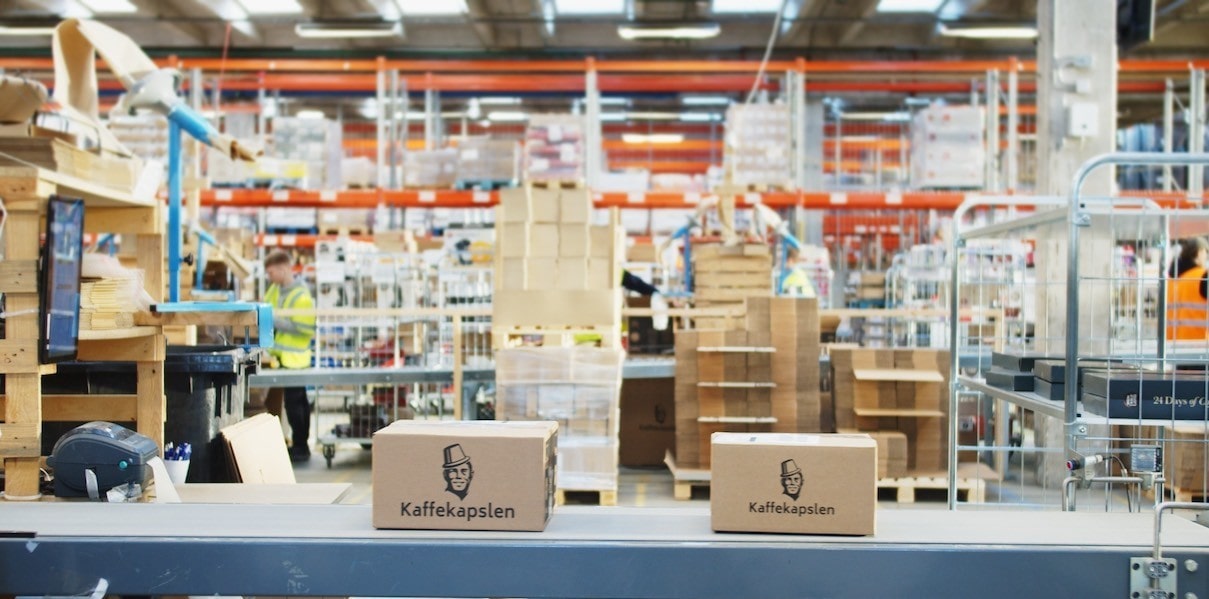
B2B is a difficult discipline. Customers each work in their own way, and their preferences and position therefore have to be given special consideration.
B2B order fulfilment can therefore be particularly tricky to optimise. In this blog post we will go through these points:
- What is order fulfilment?
- The difference between B2C and B2B order fulfilment
- Challenges with B2B order fulfilment
- What is an integration?
- Challenges with integrations
- Benefits of integrations in B2B order fulfilment
Read along here.
What is order fulfilment?
Order fulfilment is the overall process from your item being manufactured, landing on your shelf, being bought, packed, shipped and received.
If you have a company that sells goods online, you know that order fulfilment is an aspect you have to pay particular attention to. If you have good and fast order fulfilment, it undoubtedly has a positive effect on your revenue.
Imagine that you order a product yourself. You are looking forward to receiving it, but a long time passes before the product is shipped. You wait far too long for your product, and support cannot really help you. You change your mind during the process and return the product.
That has happened to many people, and it underlines the point of just how important a discipline order fulfilment is.
Good order fulfilment can therefore be described as fast, efficient, easy and cheap for all parties.
The difference between B2B and B2C order fulfilment
B2B and B2C are two completely different worlds. Where one principle can be vital in B2C, B2B is wrestling with some entirely different problems.
That also applies when talking about order fulfilment. And there are several reasons for that.
Here we go through the difference across a small handful of aspects of order fulfilment in B2C and B2B.
The customer:
Probably the most obvious difference between B2B and B2C is who is being sold to. B2C is companies that sell directly to the consumer – business to consumer – whereas B2B is selling to other companies – business to business. Naturally, this fundamental difference also has an effect on what the order fulfilment process can look like.
A B2C business has a reasonably linear order fulfilment process. Something is created, bought, shipped, received. The person who buys is the person who is contacted. That is the only decision-maker in that context.
In B2B, however, the situation can look different, because there can be several different decision-makers and coordinators involved in the buying process. That can complicate communication and, in the worst case, lower the quality of your order fulfilment if you do not build the process properly.
The product:
You know the classic webshop. You pick out a single product, maybe a couple, buy it and have it sent to your home. That is not always the case in B2B webshops. A B2B product can easily look like a B2C product. The difference, however, is most often that B2B companies sell products in larger quantities. For example food and spices for canteens and eateries. It can involve products of a larger size, or large quantities. That can quickly trigger new needs if the size of the orders exceeds what will fit in a van.
The processes:
The various needs involved in good order fulfilment differ from B2B to B2C.
B2C users typically do not have much need for different payment methods and delivery methods. The options you get as a B2C customer are pay now, or pay over time, and express delivery or normal delivery. That is all it takes.
For a B2B company there can be far more issues involved in the customer’s entire interaction with your webshop. Here there can be very particular requirements for payment methods and delivery, such as credit, up-front payments, delivery on a specific date or delivery every 3 months.
Value chains:
The value chain for a B2B company can be convoluted, depending on what you work with. If you need large products manufactured in large quantities, there can be long waiting times, which has an effect on the order fulfilment rate, that is, how long it takes for the order to get through the whole process. This requires special consideration.
Challenges with B2B order fulfilment
As you may sense, B2B order fulfilment is a difficult matter. No one company works the same way as the next, and the features needed in a B2B context can look very different from solution to solution. That is partly because B2B is a term that spans an ocean of different types of company, and partly because the customers and the products within the different companies vary. In these challenges, however, we will stick to the challenges B2B eCommerce companies face.
Manual work = poor order fulfilment:
In many B2B eCommerce companies an inappropriate amount of time is spent on manual handling of orders and data. That is something that harms your order fulfilment rate and potentially costs you revenue.
The more time you spend on a single order, the less profit is left once the customer has received the order and the order fulfilment process is over.
Manual work is therefore a huge problem for good order fulfilment and for an incredible number of B2B eCommerce companies.
Hard requirements = difficult data:
If you want to accommodate all of your customers as a B2B eCommerce company, you are biting off a big chunk. Different customers within the B2B segment can have widely different requirements of you as a company. It can be different delivery frequencies, different payment methods and perhaps even different prices, depending on the agreement.
All these different requirements placed on you as a B2B webshop create a data set that is not one-size-fits-all. The data one customer sends into your systems can look completely different from the next.
It therefore requires you to be incredibly attentive to your data and your agreements, and it creates challenges when you have to measure and optimise your processes.
Difficult to scale:
The challenges you have read about cost both a lot of time and a lot of money. Time and money you have to spend on finding and paying employees who can help you take care of the tasks. That does not hold up. It makes it harder for your company to scale and grow.
To make a company more scalable, you have to use methods that take tasks out of the hands of you and your employees.
Such as digitalising demanding processes.
What is an integration
One of the solutions to the above challenges is to use integrations between your different systems. Most eCommerce companies have a fairly extensive tech stack, which is the collection of IT systems a company uses in its daily work.
All of these tech stacks have data. Data used in analyses, in strategies, to plan resources and to optimise as well as automate complex processes.
The problem in most tech stacks, though, is that the systems are isolated from each other. In many cases the data from one system would be useful for the other system, and would remove extensive manual processes of moving data from A to B, to mention just a single one of the areas an integration could benefit.
An integration is, namely, when a bridge is built between two systems. An ERP system is a cornerstone in many eCommerce companies. This is where items are created, resources are planned and data and operations are monitored.
Wouldn’t it be smart if you could control all the other systems from your ERP system?
That is what you can achieve with integrations: that data automatically propagates to exactly where it needs to go, entirely automatically.
Challenges with integrations
Integrations are a specialisation that is not widely known in the developer world. Skilled ERP devs are few and far between, which will make it a long and gruelling recruitment process if you choose to permanently employ your own developers. In-house developers often turn out to be incredibly expensive to have on the payroll, because the need for development is far greater than the number of available developers.
Building an integration yourself will therefore require a lot of money and time to recruit, train and build a solution that fits exactly you and your programs.
Many jump into integrations without having a clear idea of the desired outcome. It makes no sense to integrate parts of your business that do not optimise processes or create more revenue.
A clear strategy for your integrations is therefore extremely important when you begin the work.
Benefits of integrations in B2B order fulfilment
The challenges of building integrations can be hard to get past, but fortunately the reward on the other side is even greater, and potentially transformative for your company.
Here are some of the benefits of integrating your systems.
Save time and money:
The biggest attraction of using integrations between your systems is without doubt the money you save when you do not have to spend time on extensive tasks in your systems. Some tasks are automated, which creates more time to optimise other things, such as your order fulfilment.
Better communication between teams:
By integrating your systems you can establish and automate the communication between your different departments.
For example, you can make sure that when an order is placed, the warehouse gets the correct information delivered that same instant, so they can quickly pack and ship the goods. All the manual processes that previously existed in handovers between teams and systems are now automated and error-proofed. That creates a secure process and faster order fulfilment.
Better communication to the customer:
Customers need to have your products communicated properly. Are the products available? If not, are there similar products? And many other aspects. It can help the customer choose the right products instead of having to spend a long time asking about and researching products. It makes sure that you get more products out to your customers.
Connectify as the supplier of your integrations
Connectify has worked professionally with integrations for several years and is one of the leading Danish specialists in the field.
We help and advise companies to get the most out of their data and optimise their processes, so that they become far more scalable and gain the opportunity to grow. B2B is our domain, which gives you the opportunity to let go and focus on tasks that make more sense to you and support your strategy better than pondering technical aspects.
We have found that we often know more about the customer’s systems than they do themselves, so you can safely hand over your data. If you need good proof, then check out our impressive cases from Shark Gaming and Kaffekapslen.
Are you curious to hear more? Reach out and let us have a chat.