Integrate your TRIMIT with your Shopify solution
When Shopify and TRIMIT do not communicate properly, you quickly end up with manual updates, error correction and data that does not add up.
When Shopify and TRIMIT have to work together, a single connection is rarely enough. Connectify’s integration platform gathers your data flows in one place, so the integration is easier to adapt and develop as the business changes.
See how an integration platform works.
How data moves between Shopify and TRIMIT
A stable integration takes more than sending data from A to B. We clarify where data is created, which fields govern, and how the systems should handle changes, errors and exceptions.
Product and variant data from TRIMIT to Shopify
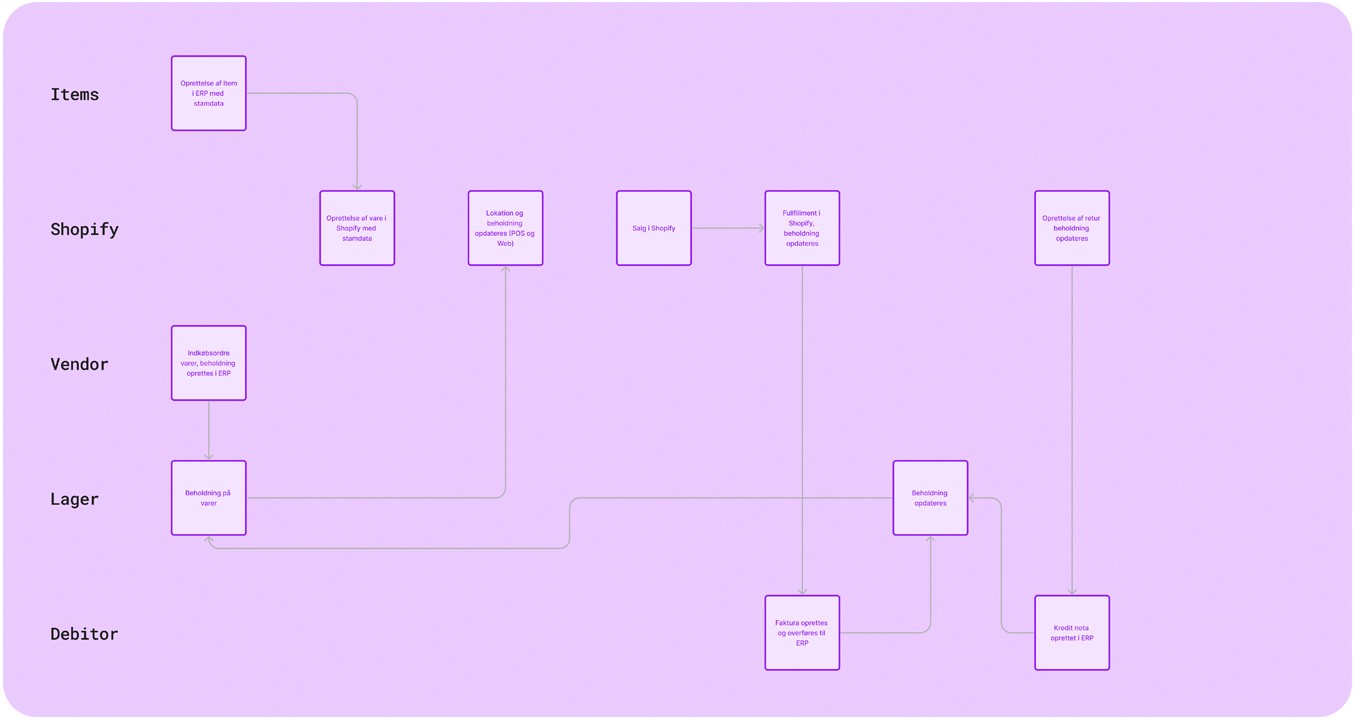
Items and variants are created and maintained in TRIMIT. The integration maps the relevant master data such as SKU, variants and product information to Shopify, so the webshop works from the same data foundation as the ERP system.
Prices and stock status across locations
Prices are retrieved from TRIMIT and linked to the correct products in Shopify. Stock status can be controlled based on the locations that are relevant for your webshop, so you avoid selling items that are not actually available.
If you have several stores, markets or stock locations, we clarify the required mapping before the integration goes live.
Orders, returns and credit notes back to TRIMIT
When a customer completes a purchase in Shopify, order data with item lines, discounts and other relevant details is sent to TRIMIT. On a return, the integration can send the event back as a credit note, so stock and finance data follow the same process.
The refund is still handled in Shopify and the chosen payment gateway, while the relevant financial event is transferred to TRIMIT.
Market, VAT and customer account logic
On B2C sales, order data can be handled via web customer accounts in TRIMIT, for example split by country of sale. That makes it possible to hit the correct VAT and accounting logic without necessarily creating an individual customer record per webshop customer.
If you have B2B trade, customer-specific prices or particular customer groups, we can adapt the integration to the logic that already exists in your TRIMIT setup.
The integration process
At Connectify we have been building integrations since 2014, and we have a solid, proven approach to setting up your integration. Here is a short description of our process.
First we map your needs. What needs to be integrated? It only makes sense to integrate the parts of your systems that you actually use, and that will create value in the future. If we added every possible feature, you could spend all your time looking at your data flow, and that is not the point.
If you spend a long time creating items and variants, we make sure the integration automates that process. We stick to what makes sense. The best way to find out what you need is to talk to the different departments about how they work and how they use the system. We can optimise your time down to the individual seconds you spend on your tasks – we just need to know where to start.
Once we have all the information, we set up the integration. The bridge is built, and you will quickly get going with your new and improved process. And if there are any problems, support is always open. Always. For us it is very important that you are not left alone with your integrations. So you get a new colleague on your team – an integration specialist – who is available when you need them.
If you are our customer, you are family.
What is TRIMIT?
TRIMIT is an ERP system most often used in the furniture and fashion industries. The system has particular features and flows tailored to specific tasks within those industries.
TRIMIT is Danish-owned and works with some of the world’s largest IT companies in strategic partnerships to continuously improve the product and how it is used. Partners such as Microsoft, Klarna and Nets. TRIMIT is a Danish company that has reached far beyond Denmark.
Read more about TRIMIT
TRIMIT as an ERP system
TRIMIT is used by large Danish fashion houses such as Ganni, Mos Mosh and Second Female, which says something about the ERP system’s quality and its fit with the fashion industry.
When you use TRIMIT you will be able to monitor and visualise your data in order to make better informed decisions about your resources. You will also be able to optimise and even automate processes that were previously manual.
With a specialised ERP system such as TRIMIT, your business scales and your resources are put to better use.
Benefits of TRIMIT
The benefits of using TRIMIT as your ERP system depend very much on what you want to use the system for and which industry you are in. Different industries have different needs.
The benefits of using TRIMIT in the fashion and furniture industries include:
- The ability to create complex variant structures
- Monitoring of processes from design to production
- Real-time inventory updates
- Fast implementation
- Cost management
- Features developed on other customers’ solutions
And what does all this mean?
When you optimise and automate your processes, they start to cost you less to run, which means you get a greater return on all the business you do. That way you get far more output from much less input. If that is not value, the word has lost its meaning.
When you upgrade your company with digital solutions such as TRIMIT, you increase your scalability. That means you can get far more output with the same, or perhaps even less, input.
ERP software gives you an overview and control of your company’s resources and processes. You can distribute responsibility between departments and make your ERP system a shared project, for better efficiency and alignment across the organisation.
Looking for an ERP partner?
Then read our guide to choosing the right ERP partner for your company.
Read our guide to choosing a partner