Guide
System architecture in a fashion business – best practice
Learn how to implement systems and integrations that improve efficiency, quality and competitiveness in your fashion business.
18 min read
Introduction
The purpose of this guide
A modern fashion business needs modern IT solutions that actually work. The fashion industry is fast-paced, and it is business critical that you are able to make the right decisions. Quickly.
A strong IT foundation, a strong business
That is why this guide exists. So you can understand exactly how important a strong IT foundation is to your fashion business’s competitiveness. Discover how different IT systems can create an ecosystem that makes your competitors sweat, and gives your employees more time for meaningful work.
Read on…
Why systems matter in the fashion industry
Systems are an indispensable part of a modern business. In the fashion industry, their importance cannot be overstated.
Systems make sure you can take informed decisions based on data, keep track of your stock, keep track of your supply chain and deliver quality products on time. Systems make the experience as seamless as possible, for you and for the end customer alike.
An overview of the different systems
We give you a clear overview of the most important systems in a fashion business’s architecture. In this guide we dive into each type of system and what it does. Whether you want to focus on one specific system or get the full picture, we help you understand how it all fits together.
The systems we will cover:
- PLM
- ERP
- PIM
- DAM
- eCommerce platforms
- 3PL (WMS solutions at your logistics partner)
- Integrations between the systems
Read along in our guide.
Product Lifecycle Management (PLM)
What is PLM, and why does it matter?
Product lifecycle management software is used to — you guessed it — keep track of a product’s complete journey, from design processes to marketing and all the way to customer feedback.
Features and benefits of PLM systems
Design: Creating new designs and collections.
Sampling: Developing and evaluating sample products.
Cost price analysis: Estimating production costs.
Sustainability analysis: Evaluating environmental and social impact.
Other benefits:
- Centralised product data management
- Efficient collaboration and communication
- Earlier error detection and lower costs
Examples of popular PLM systems in the fashion industry
Delogue:
Delogue is a sensible place to look if you are after a fully featured tool for creating prototypes and developing design processes.
In Delogue you can prototype individual garments or complete collections before you put them into production. The perfect place to experiment with all your creative elements. The tool lets you work efficiently with your colleagues and makes creative communication easy.
Infor PLM:
Infor is a complete, centralised solution that lets you handle tasks such as:
- Product design
- Overview of materials and sourcing
- Data management
- Compliance and quality control
- Supply chain overview
In short: the whole package. On top of that, it is easy to communicate with your team and work on shared projects without friction.
Centric PLM:
Centric is — just like Infor — an all-round solution where you can keep track of your products through every stage, from idea to prototype and all the way to customer data.
Centric PLM is not built specifically for fashion businesses, but it is still a fully featured system where you can work seamlessly with your colleagues on projects large and small.
Before you choose a PLM
- Choose a solution that can support your designers and the rest of the team.
- Which commercial model suits your organisation? Subscription or software purchase?
- What are you most comfortable with, a cloud solution or on-premise?
- Where should products be “born” in your business – have you defined a process?

Enterprise Resource Planning (ERP)
What is ERP, and why does it matter?
ERP stands for Enterprise Resource Planning. An ERP system helps you keep track of your products. It is often the brain of the entire system architecture in the business.
In an ERP you can keep track of finance, stock, marketing and supply chain. Everything that has to do with your business. An ERP is often connected to several other systems that send relevant data back and forth.
Why is an ERP system necessary?
In the fashion industry, supply chains, finance and stock play an enormous role. Keeping track of these different domains on three different platforms would be incredibly time consuming.
A centralised system, with a clear overview and tailored integrations, means the time you would have spent on manual analysis and reporting simply disappears.
In other words: if you want to stay competitive, your IT has to perform.
The role of the ERP system in the fashion industry
The heart of the business: Managing production, stock, orders and finance.
Production: Planning and forecasting production and sales.
Supply chain and purchasing: Managing the supply chain and procurement.
Other benefits:
- Better supply chain management
- Greater visibility and traceability
- Better decision support
Examples of ERP systems in the fashion industry
Trimit
Trimit is an ERP that includes most of the things you would expect from an ERP system.
It is reliable and relatively easy to work with. It covers supply chain, logistics, payroll and bookkeeping, and quality assurance.
Trimit is a “one-stop” ERP tailored to the fashion industry, with a focus on areas such as easy variant management and bills of material. A classic problem that many fashion brands wrestle with every day.
Microsoft Dynamics 365 Business Central
Commonly known as Business Central, or simply BC. Business Central has become the industry standard when we talk about ERP systems.
Compatibility is high, and the workflow outshines many of the old familiar names such as C5. Business Central includes everything you would expect from an ERP system. If you want to get started quickly and easily, this is where you begin.
Link to Dynamics 365 Business Central
Infor M3
In the same vein as Business Central, Infor M3 is an all-in-one cloud-based ERP provider. Keep track of your finances, your design processes and your eCommerce.
Infor M3 helps any business, regardless of size and age, to be more productive and to plan a future that makes sense.
Read also:
Key points about ERP
- An ERP helps you become productive and deliberate in every process.
- Use your ERP to quality assure every order and every product.
- Your ERP helps all departments communicate better across the business.
- Use integrations to save time and automate manual work.

Product Information Management (PIM)
What is a PIM, and how does it support fashion businesses?
A PIM system is one of the central systems in a fashion business. It is from here you send product information, prices and stock data out to all your sales channels.
The role of the PIM system in fashion businesses
Centralising product data: Many companies keep their product data in spreadsheets. That is not sustainable. A PIM future-proofs your product data and gives you easy access to it.
Selling on multiple channels: It is all about being present. A PIM system makes it easy for you to sell on several different channels at the same time, but from one single source of data.
A consistent customer experience: No matter where your customers find your products, your PIM makes sure the information, images and stock data are correct. That keeps the brand experience consistent across your channels.
Other benefits:
- Easy to work in teams on the same data.
- Valuable data insights.
- Fast time to market.
Examples of PIM systems in the fashion industry
Perfion
Perfion is a Danish-designed PIM system. It gives you a single overview of your product data, presented in a dynamic and intuitive way. Like most other PIM systems, Perfion can get you up and running in new markets and languages in no time.
Plytix
Plytix is a user-friendly PIM system that lets you use text, images and video when you present your products across channels.
With Plytix you also get data you can use to improve your sales and your products.
Struct
Struct is a major player on the PIM front. Their PIM system is widely used in Denmark and abroad, and gives fashion businesses everything they could wish for from a PIM.
Read also:
PIM implementation: a complete guide to successful product data management
Key points about PIM
- Use your PIM to create seamless product catalogues
- Make sure the customer always has the right product information.
- Break into new markets with a fast time to market.

Digital Asset Management (DAM)
DAM in the fashion industry – why does it matter?
A DAM system is where the fashion business houses its digital assets, such as images, videos and brand material. Fashion businesses depend on their visual expression — a DAM is how you make it easy to work with.
What a DAM system does in a fashion business
Centralised storage
When you work with images, video and graphics, keeping an overview and organising files is an enormous job, unless you use a DAM system. This is where you store all your visual content and the associated files in an easy, intuitive and team-friendly way.
Keep track of versions
Make sure everyone has the right version of the material every time they work. A DAM makes it easy to keep control of creative processes, with simple versioning and control.
Easy search
In a DAM system you can add metadata tags to your content so it is easy to find again.
Seamless teamwork
The entire creative team can work together easily in your DAM. With intuitive and simple collaboration tools, what used to be difficult becomes effortless.
Other benefits:
- A DAM saves an enormous amount of time compared with life without one. Time is money, but it also creates a seamless and intuitive way of working.
- Faster time to market – a DAM makes it easy to launch a collection and send it out with all the content it needs.
- Error-proof – a DAM takes the small human errors out of content production. You do not lose your files, you stay in control of versions, and you can always find your material again.
Examples of popular DAM systems in the fashion industry
Bynder
Bynder is known for its scalability. An intuitive system that suits fashion businesses of any size.
Digizuite
Digizuite gives you the option of adding metadata tags to your content, so it is easy to sort and send out to all your platforms. A DAM, like most others, with broad functionality.
Kontainer
This DAM is like the other examples: fully featured and ready to help you bring order to your content.
Key points about DAM
- A DAM system is indispensable if you want structure and order in your content
- A system that supports creative processes technically
- Perfect for creative teamwork in the cloud.
eCommerce platforms
eCommerce in fashion – why is it decisive?
An eCommerce system is what your customers use when they want to buy your product. It is your direct contact with the end customer.
Benefits and opportunities with eCommerce
Tailored experiences
Adapt the digital experience of your brand. Keep your shop up to date, your shop window dazzling and the customer experience at its best.
The opportunity for DTC sales
Sell your garments directly from production and on to the end customer.
Efficient B2B and other segments
Do you sell on to a distributor? Make it easy through your eCommerce platform. Make sure the B2B purchasing process works, and make it easy for the customer to choose the right products.
Other benefits:
- Presents products online.
- Handles online sales and customer interactions.
- Manages online orders and customer accounts.
Popular eCommerce platforms in the fashion industry
Shopify and Shopify Plus
Shopify is one of the world’s most widely used eCommerce systems and makes it easy for anyone to start their own webshop. If you have a physical store, you can easily integrate it with your webshop. B2B sales become straightforward once you are up and running.
Magento
Magento is one of the fashion world’s most popular eCommerce platforms. It requires a little more technical skill than Shopify, for example, but once that is in place, Magento is a strong choice. Magento is known, among other things, for its scalability.
Woocommerce
WooCommerce is a free plugin for WordPress. There are an enormous number of WordPress users, which makes WooCommerce a popular choice. You can upgrade your WooCommerce business with free plugins that make the user experience more seamless. But be careful: the quality of these plugins varies.
Key points about eCommerce
- This is where your customers meet you when they want to buy
- Your eCommerce system is connected to the rest of your systems (ERP, DAM, PIM)
- With integrations and plugins, your eCommerce system can create seamless and easy user experiences.
Third Party Logistics (3PL)
What is 3PL, and why is it relevant for the fashion industry?
Fashion businesses use 3PL providers to handle logistics and distribution processes in the most efficient and straightforward way.
3PL options and benefits
Order fulfilment: Picking, packing and shipping orders.
Returns: Handling returned goods and refunds.
Warehouse optimisation: Adjusting storage space and resources.
Other benefits:
- Storage and stock management
- Order processing and shipping
- Returns handling and customer support
Choosing the right 3PL
DSV contract logistics
DSV has some of Denmark’s most extensive warehousing options. That opens up many possibilities if you need your goods stored and distributed close to your end customers. DSV operates more than 500 warehouse facilities, and their teams tailor solutions to fit your business.
Link to DSV contract logistics
DKI Logistics
DKI offers data-driven and automated warehouse solutions. That means you get a dependable 3PL partner that understands the importance of modern business operations. Like DSV, DKI operates both internationally and locally.
DFDS third-party logistics
DFDS allocates warehouse and logistics solutions based on your specific needs. DFDS is an international provider, which means easy access to new markets.
Key points about 3PL
- Make sure the 3PL can offer the specific logistics services you need.
- Check that the 3PL’s technology can be integrated with your own software.
- Choose a 3PL that can grow and adapt along with your business.
- Make sure the 3PL has a good reputation and can deliver reliably and on time.
Integration architecture in the fashion industry
As you may have gathered from this guide, there are many different systems that all have a place in the fashion industry. You can quickly find your hands full if you have to work in every single one of them yourself.
This is where integrations come into the picture.
An integration is, quite simply, a bridge. For example, a bridge can be built between your PIM and your ERP. When you update something in your ERP, it is automatically copied across to your PIM, and vice versa. Integrations are a must if you want to reach your business’s highest level of productivity. Integrations save you time, money and hassle.
Tasks that run across systems
Below you can see a simplified version of the tasks that take place across your systems. This is where integration makes sense.
Design and product development:
Everything begins with PLM, where product ideas become concrete designs and specifications.
Production and stock:
Your ERP system takes over, organises production and manages stock, including products from 3PL providers.
Product information:
Your PIM ensures that all product data is consistent and correct across every sales channel, and shares it with the eCommerce platform.
Customer interaction in eCommerce:
On your eCommerce platform, customers can see products based on data from PIM and DAM, and buy them. These orders are passed back to the ERP and on to the 3PL for delivery.
Delivery and stock:
3PL partners make sure online customers receive their orders, and update the ERP system with shipping and stock information.
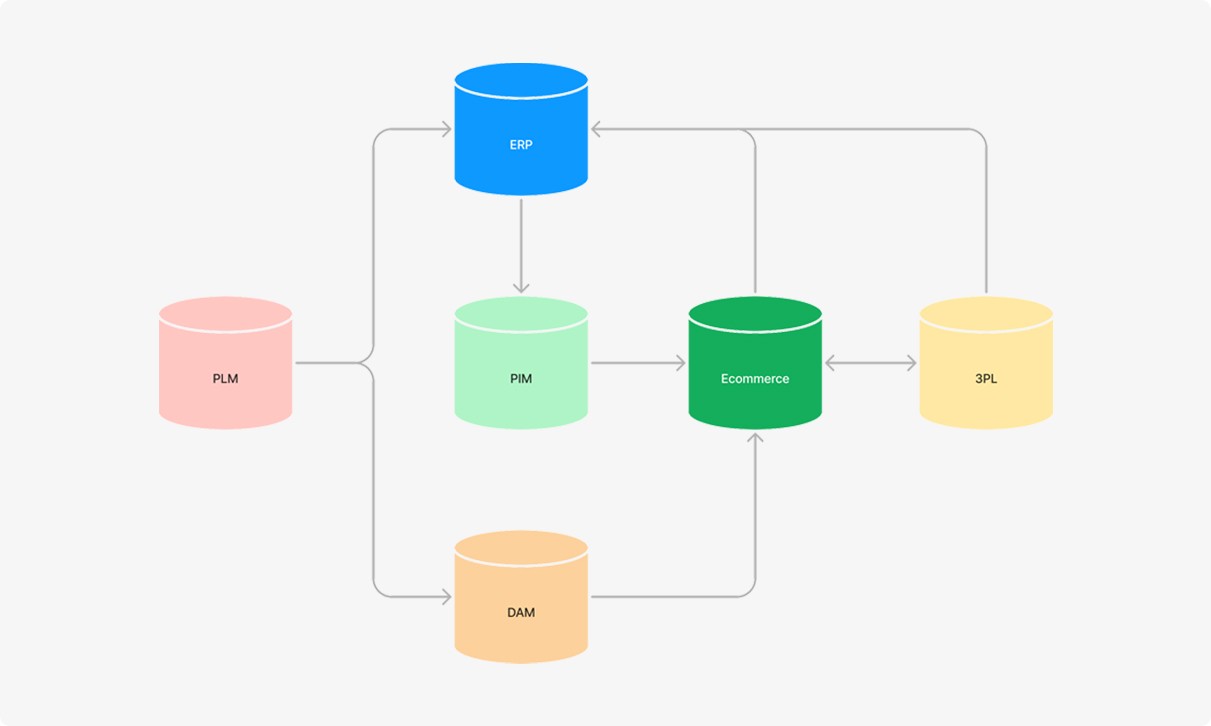
Data flow
Let us take a deeper look at each of these systems and how they can be integrated in a fashion business:
PLM
- Sends detailed product specifications and designs to the ERP.
- Can share design files and images with the DAM.
ERP
- Receives product specifications from the PLM, used for production.
- Shares product and stock information with the PIM.
PIM
- Receives basic product data from the ERP and/or PLM.
- Sends enriched product information to eCommerce and can share it with the DAM.
DAM
- Can receive and send media files to and from PIM and eCommerce platforms.
Ecommerce
- Receives product data and digital assets from PIM and DAM.
- Shares order data with the ERP and possibly the 3PL for fulfilment.
3PL
- Receives orders from the ERP or eCommerce.
- Updates the ERP with stock status and shipping details.
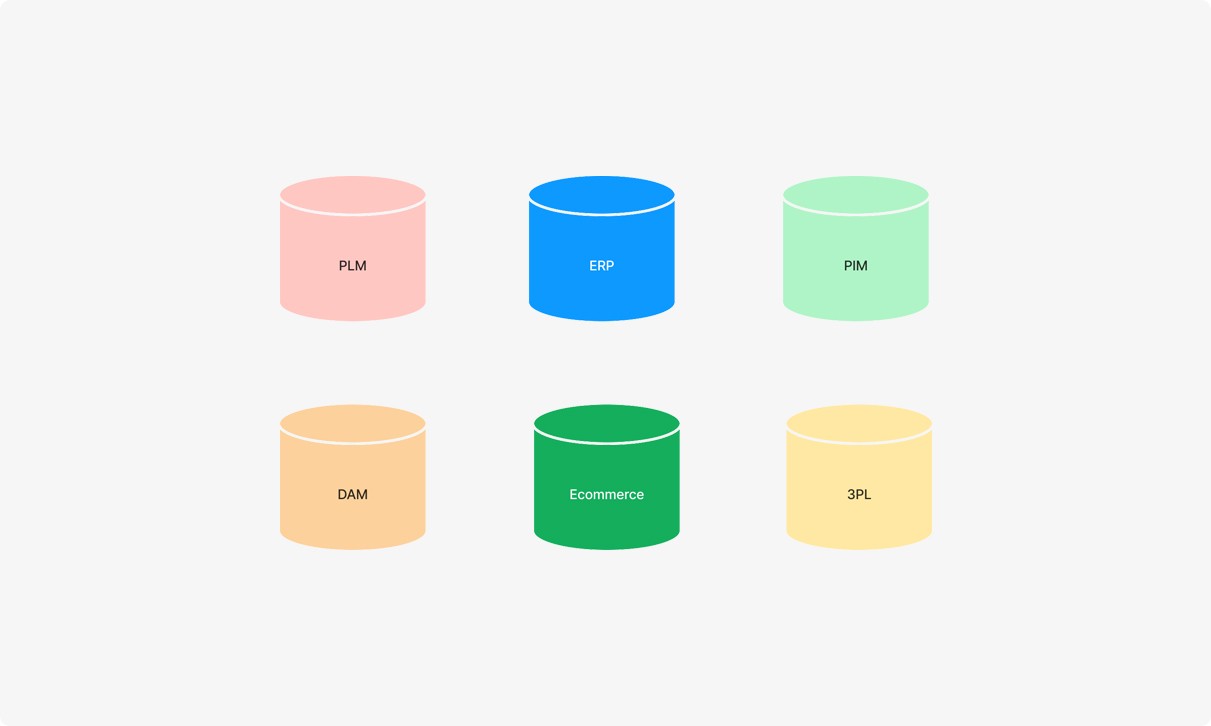
This is what you can integrate
The possibilities are almost endless when it comes to integrations. We have put together a list of the most popular options.
PLM to ERP
- Product name and ID
- Design files (images, CAD files and so on)
- Material and component list
- Size and colour variants
- Manufacturing instructions
ERP to PIM
- Product name and ID
- Price
- Available stock
- Production time and status
- Supply chain information
PIM and DAM to eCommerce
- Product name and ID
- Description
- Price
- Images and videos (from the DAM)
- Size and colour variants
- Stock status (optional)
eCommerce to ERP
- Order ID and status
- Customer information (name, address, contact details)
- Ordered items (item number, quantity, price, etc.)
- Payment status and method
- Shipping information
ERP to 3PL
- Product ID and quantities
- Stock location
- Order ID and details
- Shipping method and preferences
- Customer delivery address and contact details
3PL to ERP
- Order ID and status
- Delivery tracking number
- Updated stock status per product
Read more about our integrations
Key points about integrations
- Integrations may look like a lot of effort, but they can save you a huge amount of time and money.
- Without integrations, your systems require a fair amount of manual work.
- No two businesses are alike. Integrations have a tendency to become too standardised.
- Choose an integration partner to build the integrations that fit you.

Mapping your systems and integrations
Ask the right questions
Are you in doubt about which systems to choose? Perhaps you do not even know whether all those systems are necessary. Here are a number of questions you should ask yourself.
They will tell you clearly whether you are covered, or whether you should consider one of the systems above:
Strategy and goals
- What are the company’s overall business goals and strategy?
- How are technology investments and digital transformation prioritised?
Product development and design (PLM)
- How is the product development process managed from concept to production?
- How are design and product data handled?
- Is there a centralised system for storing and sharing design files and product information?
Production and stock management (ERP)
- How are production processes and stock levels managed?
- Is there a system for keeping track of stock and production data in real time?
- How are the supply chain and supplier relationships monitored and managed?
Product information (PIM)
- How is product information handled and centralised?
- How is consistent product information ensured across different sales channels?
Digital media (DAM)
- How are the company’s digital assets, such as images and videos, organised and accessed?
- Is there a system that helps share these assets across different platforms and channels?
eCommerce (online sales)
- How are online sales and customer interactions managed on digital platforms?
- How are online sales and orders integrated with warehouses and distribution centres?
Warehousing and distribution (3PL)
- How are warehousing and distribution of products to customers and retail stores handled?
- Is this handled in-house, or is a 3PL partner involved?
Data flow and integrations
- How is data sharing and integration between different departments and systems ensured?
- Are there challenges or bottlenecks the team faces in terms of data access or data sharing?
Challenges and future plans
- What are the current challenges in relation to data handling, product development or customer service?
- Are there plans to upgrade or change any of the current systems or processes?
Security and compliance
- How is data secured, and how is compliance with legislation and standards handled?
Key points about mapping and the questionnaire
- Answer as many questions as possible about the purpose of the systems.
- Specify the critical functions the systems must include.
- Work out what an intuitive user interface looks like – one your employees will love!
- Consider how you will determine the total cost of ownership for the systems.