Integration between Shopify Plus and Dynamics 365 Business Central
If you run your own Shopify store, or work with Shopify day to day, you know that things get complex fast once it has to talk to Dynamics 365 Business Central.
With the Connectify iPaaS solution you get access to a leading integration service between Shopify and Business Central 365.
Connectify scales with your business without changing the budget.
Our iPaaS is optimised every day on the basis of the many thousands of syncs that run through it, and you do not have to worry about changes in your ERP or in Shopify’s API – we make sure to adapt to the changes as they happen.
Shopify Business Central integration
With a Shopify Business Central integration you get one connected system that automatically synchronises orders, stock status and customer data between your Shopify webshop and Dynamics 365 Business Central.
That saves you time, ensures higher data quality and makes it easier to scale your e-commerce business.
What can be synchronised?
There are almost no limits to the connections and synchronisations we have worked with.
If you have particular data, we can send it where you want it. Here are the most commonly used data types in Shopify and 365 BC.
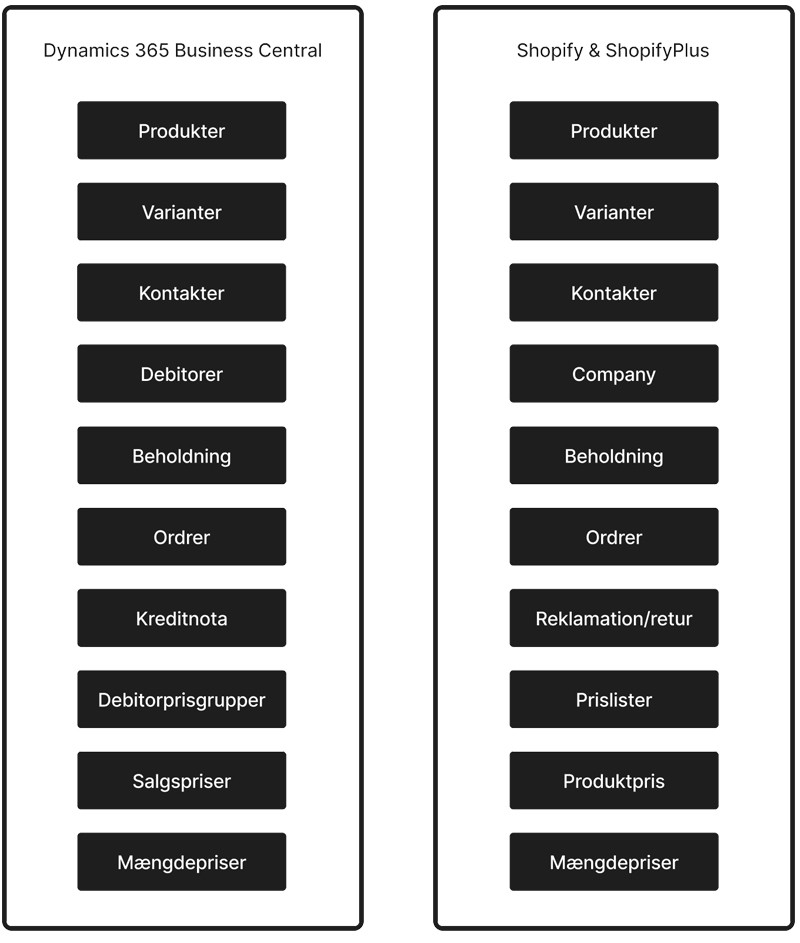
How the integration between Shopify Plus and 365 Business Central works
When you integrate Shopify Plus with Dynamics 365 Business Central through Connectify, you get a stable and monitored data flow that ensures correct transfer of orders, stock status, prices and customer data – in real time.
Technical setup and configuration
- API connections: We use the Shopify Admin API and OData v4 / Web Services in Business Central.
- Validation layer: Data is validated before transfer – for example VAT number, stock quantity, customer groups.
- Mapping and logic: SKUs, locations and price groups are mapped so they match between the systems.
- Security: All data transport is encrypted, and access is handled via OAuth 2.0 and token management.
- Error handling: All flows are monitored and logged in Connectify Cockpit with notifications.
Typical configurations in B2B e-commerce
- Customer-specific price agreements: Shown automatically in Shopify based on the customer’s price group in BC.
- Multiple stock locations: Orders are routed automatically depending on sales country and product.
- Credit limit control: The order is validated against the credit status in BC before it is accepted.
- VAT and terms per customer type: Automatic setup of VAT, payment and delivery based on customer data and region.
Read more: B2B Shopify and Shopify Plus: guide to B2B e-commerce
Which APIs are used in the integration?
Connectify’s integration between Shopify Plus and Dynamics 365 Business Central is built on documented, modern APIs that ensure stable and secure data transport between the systems.
Shopify Plus – the APIs we use
| API |
Function |
| GraphQL API |
Retrieves orders, customers and products and updates stock and prices |
| Storefront API |
Used where customer data and price logic need to be retrieved live (for example B2B) |
| Webhooks |
Triggered on order creation, changes in product data, returns and more |
| Multipass API (optional) |
For single sign-on between external systems and Shopify |
Business Central – APIs and technologies
| API / technology |
Function |
| OData v4 (standard API) |
Reads and writes data to tables such as SalesOrders, Items, Customers |
| Web Services (SOAP/OData) |
Used with older BC/NAV installations, particularly for custom tables |
| Page Extension APIs |
Used when BC needs to be extended with customer-specific fields |
| Job Queue / Codeunits |
For advanced data processing and asynchronous calls inside BC |
Read more: Understanding endpoints in the Microsoft Dynamics 365 Business Central v2 API
What can integrations do for you?
Summing up the potential of integrations in a short explanation is a bit like asking someone to fit a mountain into their trouser pocket. It is not really possible.
Integrations have enormous potential.
Better collaboration inside the company
An integration does not only reduce the workload for you. It can help you, and the rest of the company, communicate better across departments.
Shopify Plus Dynamics NAV integration
With an integration between Dynamics NAV and Shopify Plus you can:
- Synchronise orders and customers between Shopify Plus and Dynamics NAV.
- Update inventory and product data automatically in real time.
- Transfer invoices and payments directly to NAV.
- Support both B2B and B2C workflows.
- Handle several Shopify stores in the same integration.
Read more: Shopify Dynamics NAV
Challenges with the native 365 BC integration to Shopify?
Missing features
Out of the box there are many useful features, but it quickly runs short.
Missing expertise
Your ERP partner is not an e-commerce expert, and your Shopify partner is not strong on 365 Business Central.
Missing fit
The native integration is built to a standard that others have decided – and your business is not like everyone else’s.
Read more about the native 365 BC integration to Shopify.