
NAV webshop: optimise your webshop with Microsoft Dynamics NAV integration
Boost your online business with a NAV webshop that integrates seamlessly with Microsoft Dynamics NAV. Streamline e-commerce and optimise customer service 🚀
· 13 min read
Does your company run on Microsoft Dynamics NAV, and are you considering expanding with a webshop? Then you have come to the right place.
An integration between your webshop and your NAV ERP system can be the key to streamlining your processes, improving the customer experience and growing your online business.
But how do you get started, and what should you be aware of?
We dive into that here, where we go through:
- The benefits of integrating Dynamics NAV with your webshop
- Different types of webshops and platforms
- Important considerations before the integration
- Differences between B2C and B2B integrations
- Options for connecting multiple data sources
- Supported NAV versions and upgrading to Business Central
- Concrete cases from companies that have taken the plunge

Microsoft Dynamics NAV and e-commerce
If your company uses Dynamics NAV as its preferred ERP system, you are not alone. NAV is a central part of many companies’ daily operations and management of financial processes. It is a fantastic tool that helps you keep track of everything from inventory management to bookkeeping.
But what if you also want to sell your products online?
This is where integrating NAV with a webshop comes into the picture.
By connecting these two systems you can create a more streamlined and efficient online commerce platform.
Imagine that your webshop automatically updates the stock levels when a customer makes a purchase. Or that orders from the webshop go straight into NAV, so you avoid manual data entry. Those are just a couple of examples of how an integration can make life easier for you and your company.
The benefits of integrating Dynamics NAV with your webshop
There are plenty of good reasons to integrate your Dynamics NAV ERP system with your webshop. Here are a few of the most important benefits:
**Automation of business processes
**By synchronising data between your webshop and Dynamics NAV you can reduce manual work and errors. That means you can:
- Save time entering orders
- Avoid errors in stock levels and prices
- Automate invoices and payments
In short, integration makes life easier for you and your employees. You can focus on growing the business instead of drowning in manual work.
Personalised customer experiences
With real-time data from Dynamics NAV you can offer your customers a tailored experience in your webshop. That could for example be:
- Customer-specific prices based on previous purchases or agreements
- Product recommendations based on the customer’s history
- Display of stock levels, so the customer knows whether the item is in stock
By giving your customers a personal experience you can increase customer satisfaction and loyalty. And satisfied customers usually mean more repeat purchases and positive word of mouth about your company. Win-win!
So if you want to make your business more efficient and give your customers a better experience, integration between Dynamics NAV and your webshop is the way forward.
It is not exactly rocket science, buuut… it does take a bit of technical know-how.
Don’t worry – we have that completely covered, so you can focus on what you do best.

Which type of webshop do you want?
When choosing the right webshop for your company, it is important to consider which type of customers you are addressing.
Is it other companies or individual consumers? Or perhaps both?
Let us dive into the different options:
B2B (Business-to-Business)
- If you sell to other companies, B2B is the way to go.
- Here the focus is on complex approval flows and volume-based prices.
- It can be a slightly more convoluted process, but it is worth it if your customers are other businesses.
B2C (Business-to-Consumer)
- If you are addressing individual consumers, B2C is your best friend.
- Here it is all about fast transactions and a user-friendly buying experience.
- It has to be easy and straightforward for your customers to shop with you.
D2C (Direct-to-Consumer)
- If you are a manufacturer and would like to sell directly to consumers, D2C is the way forward.
- With D2C you have greater control over your brand and the customer experience.
- It can be a good way to stand out from the crowd and create a unique experience for your customers.
So which type of webshop suits your company best? That depends entirely on your customers and your goals.
Read more about DTC in our guide: Take full control of your brand with DTC: a guide to selling directly to the consumer

Which platform can you use for your webshop?
There is an ocean of different platforms out there when it comes to building a webshop. But if you want something that works well with NAV, there are three in particular you should keep an eye on:
Shopify
- Known for being super user-friendly and quick to set up
- Offers comprehensive integration with NAV, so you can get your data to flow smoothly
Read more about Dynamics NAV integration for Shopify: Shopify Dynamics NAV
Magento
- An open-source platform that is perfect for larger companies.
- Allows tailored solutions and deep integration with NAV, so you can get exactly what you need.
Read more about Magento integration: Magento integration
WooCommerce
- A WordPress plugin that is ideal for small to medium-sized companies
- Offers simple integration with NAV, so you can get started without too much hassle
Read more about WooCommerce integration: WooCommerce Integration
So whether you are a large company with complex needs, or a smaller outfit that just needs things to work, one of these 3 platforms is your answer to a solution.
The most important thing is that you choose a platform that can talk well with your NAV system and your needs. That way you avoid the headache of data that does not flow properly, and you can focus on selling your goods instead of fiddling with the technology.

What should you know before integrating?
Before you throw yourself into integrating your NAV system with your webshop, there are a couple of things you need to have in place. One of the most important is to carry out a thorough preliminary analysis.
Why is that so important, you might be thinking?
Well, you see, a preliminary analysis is like checking whether you have all the ingredients before you start baking a cake. You would rather not be standing in the middle of it all and discover that you are missing some critical element, would you?
It involves, among other things:
- A review of your current data structures
- A check of your work processes
- An assessment of your system compatibility
The purpose of this exercise is to identify any challenges or need for adjustment before the integration itself gets under way. That way you avoid unpleasant surprises along the way and secure a smoother process.
So take the time for a proper preliminary analysis before you throw yourself into the integration. Your future self will thank you for it!
Pssst…
Not quite sure what to look for?
Then feel free to give us a call and we will take a look at it together.

Differences in data in B2C and B2B integrations
When we talk about integrations between webshops and ERP systems such as Dynamics NAV, there are some quite marked differences in which data is in play, depending on whether it is B2C or B2B.
B2C integrations
- Here we typically deal with large volumes of customer data. So we are talking about end users who shop in the webshop.
- There are often many transactions, so the system has to be able to handle a large volume.
- The focus is often on creating a personalised customer experience, so data about the individual customer’s preferences and history is important.
B2B integrations
- Here we are often dealing with more complex data exchanges.
- That could for example relate to customer accounts, contacts, price logic, orders, invoicing and inventory management
- Efficiency and accuracy are paramount. Things just have to work, every time.
A good example of a typical B2B situation could be if you are a supplier to retail shops. Here different orders have to be sent to different shops, and there may be partial invoicing.
So that places different demands on the integration than if it is “just” a webshop aimed at end users.
Whether it is B2C or B2B, the point is that you need to be clear about which data is important in your specific setup. That way you can make sure the integration will work optimally and support your business in the best possible way.
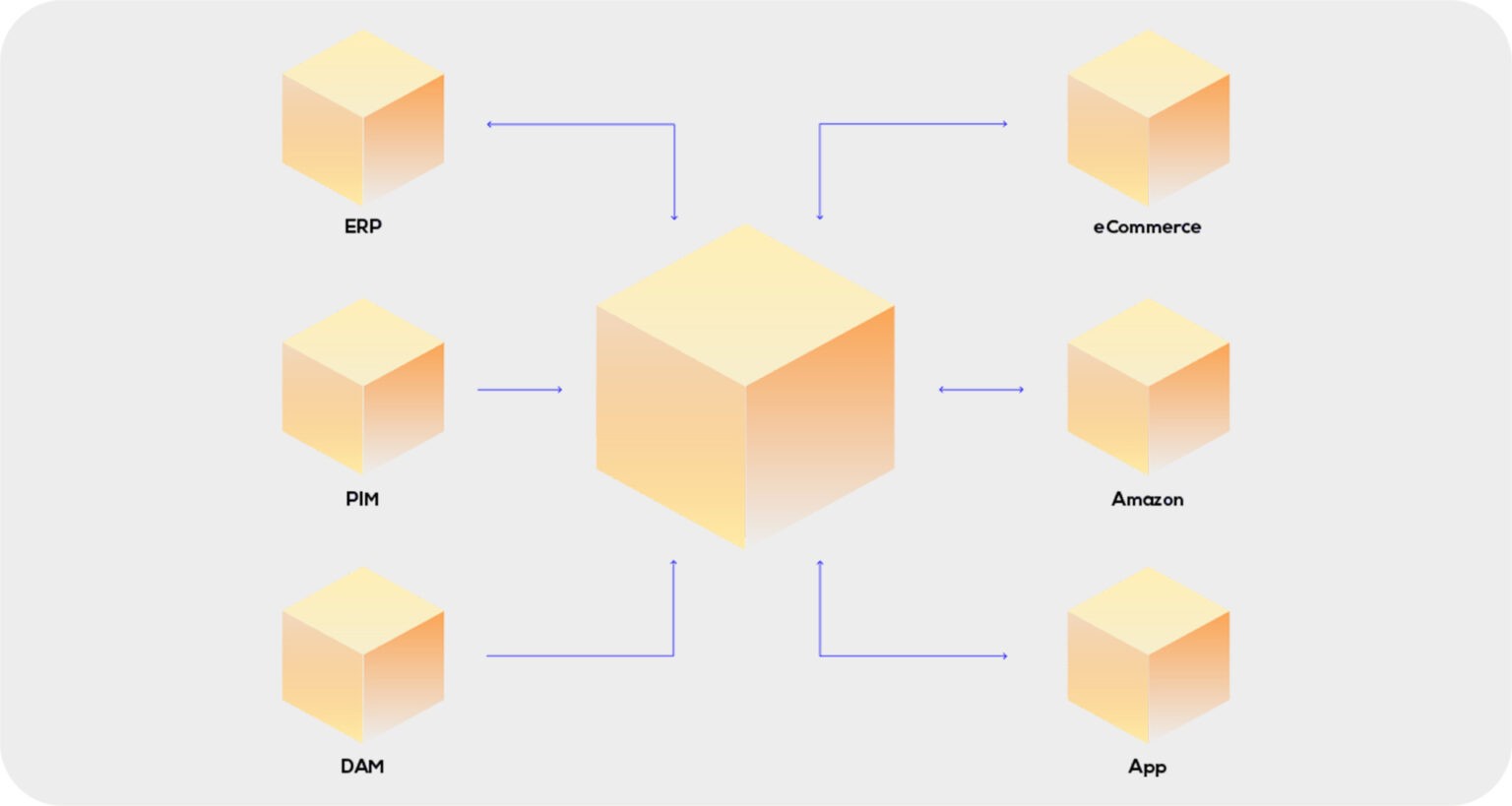
The option of connecting multiple data sources
Once you have got a taste for integration, you will discover that there are many more possibilities than just connecting your webshop with Dynamics NAV.
Think for example about how you handle your product information. If you use a PIM system (Product Information Management), you can benefit from integrating it with Dynamics NAV and your webshop. That way you always have control of your product data, no matter where it is used.
We can integrate Plytix PIM, read more: Plytix integration
What about warehousing and logistics?
If you use a 3PL (Third-party Logistics) to manage your warehouse, integration with their WMS (Warehouse Management System) can do wonders for your efficiency. You avoid manual data entry and the risk of errors, and your customers get a better experience with faster and more accurate deliveries.
The possibilities are almost endless when it comes to integration. It is just a matter of thinking creatively and finding the areas where you can optimise your processes and save time and resources. (again, something we are happy to help with)
So if you want to get the most out of your Dynamics NAV solution, consider connecting it with other systems in your company. It really can give you a competitive advantage and make your everyday work much, much easier. It can be realised with an integration platform, where you can connect one or more data sources in your system architecture.
Read more about the integration platform: Integration platform
Which version of NAV do we support?
When it comes to NAV, we have been in the game for many years by now. We have seen the system develop from version to version, and we have helped companies get the best out of each and every one of them.
Are you sitting there thinking: “Hmm, I wonder whether they can help me integrate my webshop with my specific version of NAV?”
Then the answer is: YES!
We specialise in supporting all versions of NAV from 2009 R2 right up to NAV 2018. And yes, that also includes all the versions in between.
Versions we support:
- Microsoft Dynamics NAV 2009 R2 (Release Date: December 2010)
- Microsoft Dynamics NAV 2013 (Release Date: October 2012)
- Microsoft Dynamics NAV 2013 R2 (Release Date: October 2013)
- Microsoft Dynamics NAV 2015 (Release Date: October 2014)
- 5.Microsoft Dynamics NAV 2016 (Release Date: October 2015)
- Microsoft Dynamics NAV 2017 (Release Date: October 2016)
- Microsoft Dynamics NAV 2018 (Release Date: December 2017)
- Dynamics 365 Business Central Spring 2018 Release
So in short, whichever version of NAV you are running, there is no need to be nervous. We have it covered, and we are ready to help you get the best out of your system.
And if you are considering taking the plunge to Dynamics 365 Business Central, we are of course also ready to guide you through that process. You can read more about that in the next section.
Planning to move to 365 Business Central?
Are you in a company that uses Dynamics NAV, and are you considering moving to Dynamics 365 Business Central? Then we have good news for you!
We can help you build an integration that works with both NAV and Business Central. That way you can start by integrating your webshop with NAV and later move the whole solution over to 365 BC without having to start over. Smart, isn’t it?
But why consider switching to 365 BC at all? Here are a few good reasons:
- A modern ERP system in the cloud: Business Central is a cloud-based ERP system with automatic updates and features you will not find in the older NAV systems.
- Improved integration: With Business Central you get far better integration with Microsoft’s other cloud applications. That means you can collaborate more efficiently and exchange data across the systems.
- Advanced data analysis and ease of use: Business Central offers advanced data analysis and intuitive user interfaces that make it easier and faster to work with your business processes.
- Support for modern technologies: Unlike NAV, Business Central uses newer technologies that are better equipped to handle modern business requirements.
- Security and compliance: Business Central is developed to comply with the new bookkeeping act, so you can be sure you are on the right side of the law.
- Scalability and flexibility: With Business Central you get a system that can scale in step with your company’s growth and that can easily be adapted when things change. That makes the system future-proof.
- A single version of master data: In Business Central you work with only one version of your important master data. That makes sure your information is always consistent and accurate across the entire company.
So if you are thinking about upgrading from NAV to 365 Business Central, there is nothing to stop you getting started. We are ready to help you all the way, whether you want to start with a NAV integration or jump straight onto the 365 BC bandwagon.
Read more about migrating from NAV to Dynamics 365 Business Central: Go from NAV to Business Central without losing a fortune
Cases
Now we have talked a lot about the technical aspects and the possibilities of integrating your webshop with NAV. So now it is probably also time to take a look at a couple of real examples, so you can see how it works in practice.
Because the best webshops have already seen the light, and we would like to share a couple of cases from a small selection of our customers:
Shark Gaming Systems A/S
Shark Gaming specialises in gaming equipment, and they have been through an exciting journey. They started by integrating their Magento Community E-commerce platform with NAV, but later decided to upgrade to Adobe Commerce.
At the same time they switched their ERP system from NAV to Microsoft Dynamics 365 Business Central. That sounds like a big mouthful, but with help from us and our partner JCD A/S they secured a seamless transition and a complete cloud-based system. Now it is just running along nicely!
Kaffekapslen.dk
Kaffekapslen.dk is the largest retailer of coffee capsules in the Nordics and Germany. They are busy supplying coffee-thirsty customers across the whole region, and that requires having things under control.
That is why they work with us and Notora A/S on integrating their Magento 2 E-commerce platform with the 365 Business Central ERP system. It gives them a full overview of stock and sales data, as well as the support they need to continue their international growth. Coffee and growth, now that is a good combo!
So there you have a couple of examples of how companies in the real world use integrations between their webshop and ERP system to streamline processes, get a better overview and support growth.
See more references: References
If that sounds like something for you, then you know where to find us!